
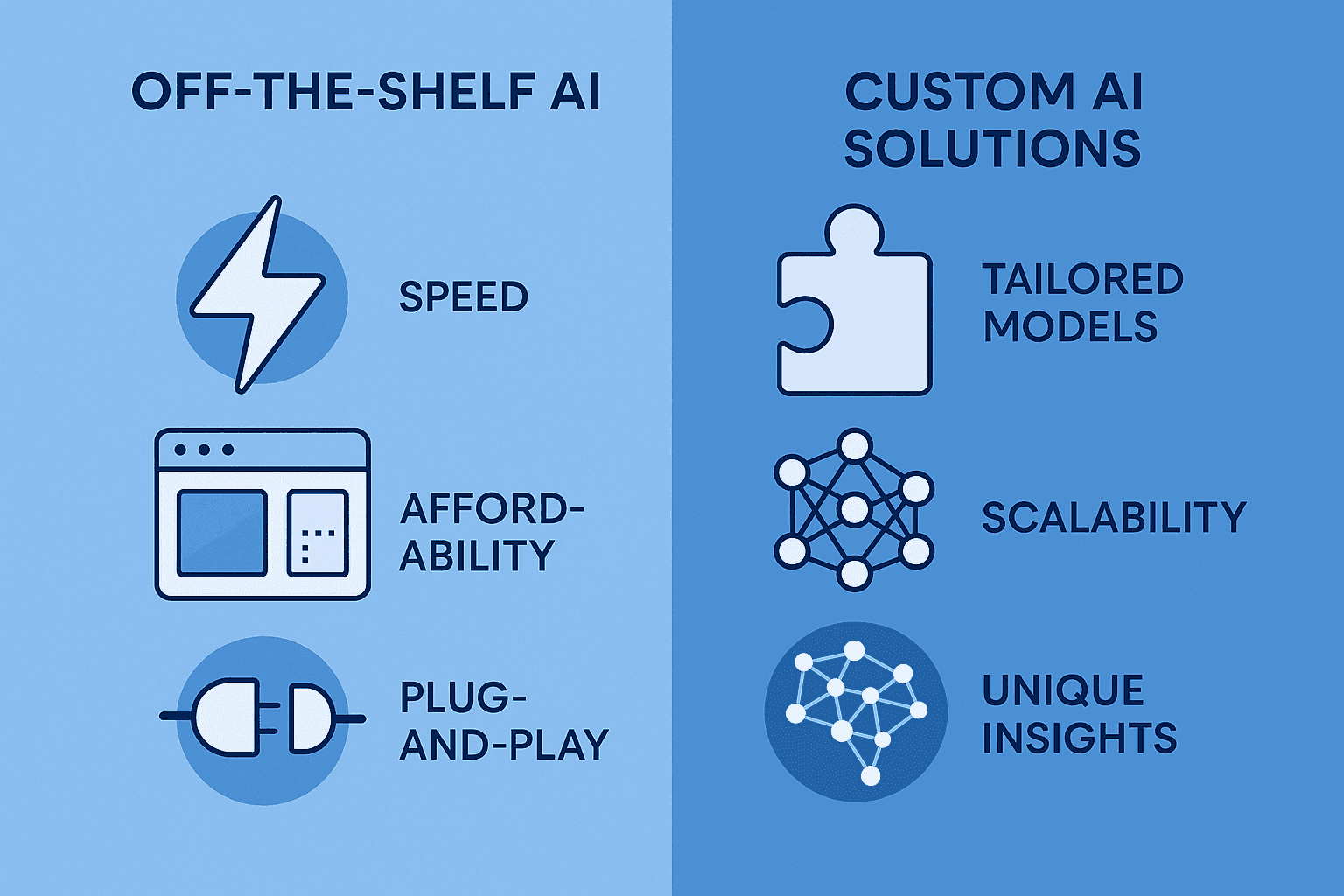
Artificial Intelligence (AI) has shifted from a futuristic concept to a critical enabler of business growth and efficiency. Today, companies across industries—from retail and healthcare to logistics and finance—are leveraging AI to streamline operations, personalize customer experiences, and gain a competitive edge.
Yet one of the first strategic decisions organizations face is whether to adopt off-the-shelf AI software or invest in custom AI solutions. This build vs. buy AI dilemma carries profound implications for scalability, adaptability, cost, and long-term success.
In this article, we’ll dive into the pros and cons of each approach, explore when to choose one over the other, and highlight how tailored AI models can unlock unique opportunities that generic software simply can’t match.
Understanding Off-the-Shelf AI Software
Off-the-shelf AI software refers to pre-built, ready-to-use applications designed to solve common problems. Examples include:
• Chatbots for customer support
• AI-driven recommendation engines
• Computer vision APIs for image recognition
• Predictive analytics dashboards
These tools are built to serve a wide range of users and industries, often with plug-and-play functionality.
Advantages of Off-the-Shelf AI
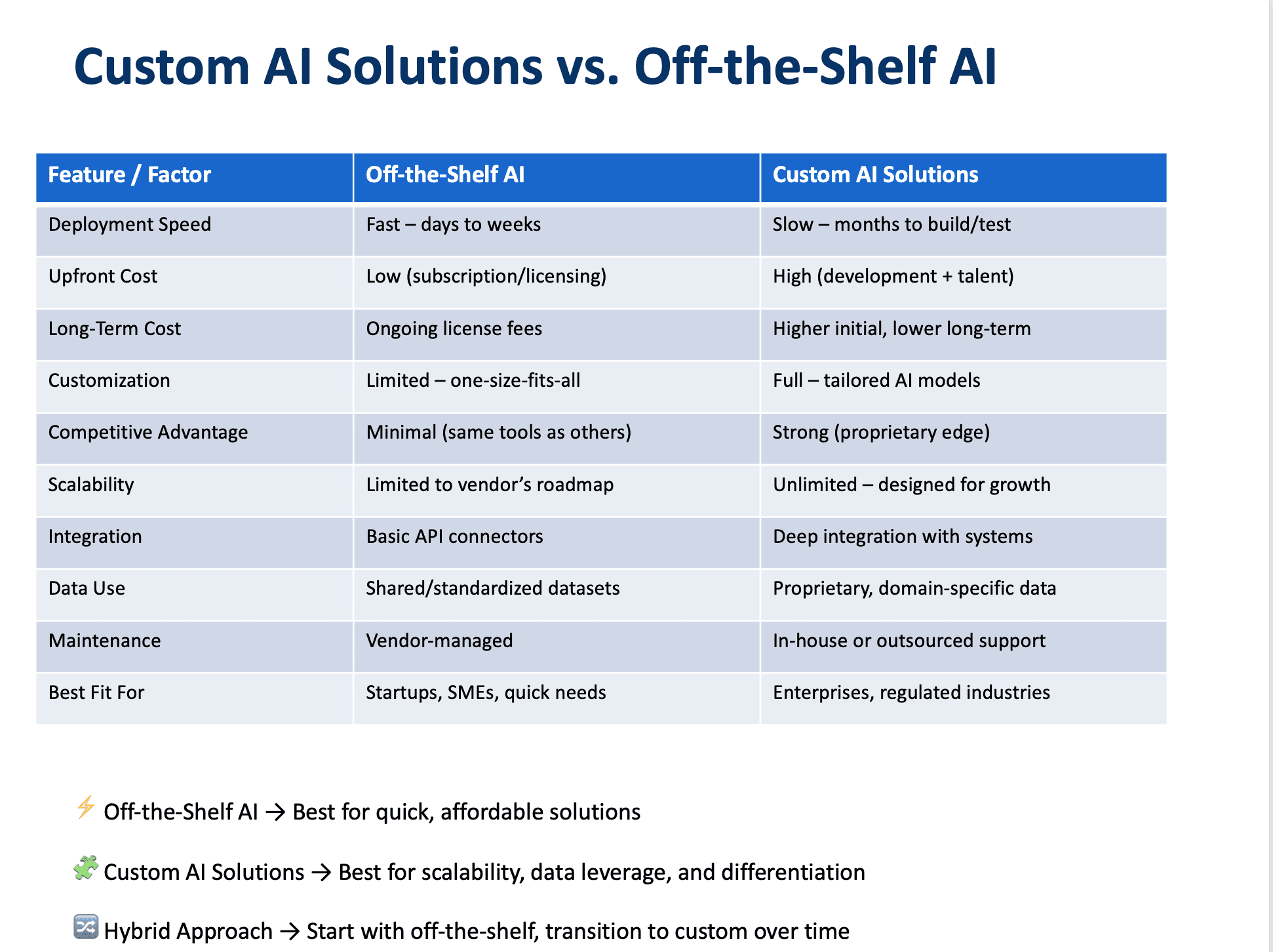
1. Quick Deployment – Minimal setup time allows businesses to start using AI within days or weeks.
2. Lower Upfront Cost – Subscription or licensing models make it accessible for small and mid-sized businesses.
3. Proven Reliability – Tested across thousands of users, these solutions are generally stable.
4. Ease of Use – Designed with user-friendly interfaces and pre-set features.
Limitations of Off-the-Shelf AI
1. Limited Customization – Businesses often must adapt their processes to fit the software, not the other way around.
2. Scalability Constraints – As companies grow, these tools may not evolve with increasing complexity.
3. Competitive Parity, Not Advantage – If competitors use the same tools, differentiation is difficult.
4. Vendor Lock-In – Dependence on a provider’s roadmap and pricing can limit flexibility.
________________________________________
What Are Custom AI Solutions?
Custom AI solutions are tailor-made systems developed specifically for a company’s unique requirements. These solutions may involve designing tailored AI models, integrating AI into existing infrastructure, or building end-to-end platforms that address niche challenges.
For instance:
• A logistics firm may build a custom AI to optimize delivery routes using its proprietary data.
• A healthcare provider could develop a model that predicts patient risks based on specific demographics.
• An e-commerce retailer might design a recommendation system aligned with its unique buyer behavior data.
Advantages of Custom AI Solutions
1. Perfect Fit – Models are built around the company’s workflows, goals, and datasets.
2. Competitive Differentiation – Proprietary AI can become a long-term strategic asset.
3. Scalability – Designed with future growth and complexity in mind.
4. Data Leverage – Organizations can maximize the value of their proprietary data.
5. Integration – Smooth alignment with existing infrastructure and tools.
Limitations of Custom AI Solutions
1. Higher Initial Investment – Requires skilled developers, data scientists, and time.
2. Longer Deployment Time – Projects may take months to develop and test.
3. Ongoing Maintenance – Models need regular updates, monitoring, and retraining.
4. Specialized Talent – Hiring or outsourcing expertise is necessary.
________________________________________
Build vs. Buy AI: Key Factors to Consider
When facing the build vs buy AI decision, businesses should assess:
1. Business Goals
• If you need a quick solution for a common task (like chatbot support), off-the-shelf is efficient.
• If AI is core to your competitive advantage, custom AI solutions are a better long-term investment.
2. Budget
• Off-the-shelf tools spread costs through subscriptions.
• Custom solutions require higher upfront costs but may reduce long-term licensing expenses.
3. Time-to-Market
• Urgent needs lean toward ready-made tools.
• Long-term strategic initiatives justify longer custom development timelines.
4. Data Sensitivity & Privacy
• Proprietary or sensitive data often demands custom AI models to ensure compliance and security.
5. Scalability & Flexibility
• If future adaptability is critical, custom AI solutions ensure growth without hitting vendor limits.
Use Cases: When Each Makes Sense
When Off-the-Shelf AI Works Best
• Startups & SMEs needing affordable, fast AI adoption.
• Generic use cases like sentiment analysis or OCR.
• Temporary projects where customization isn’t cost-effective.
When Custom AI is the Better Choice
• Enterprises seeking differentiation and proprietary advantage.
• Data-rich industries like healthcare, finance, or e-commerce.
• Complex workflows requiring deep integration.
• Regulated sectors where compliance is non-negotiable.
Hybrid Approach: The Best of Both Worlds
Some companies adopt a hybrid model:
• Start with off-the-shelf AI to gain momentum.
• Gradually transition to custom AI solutions as needs evolve.
• Combine generic tools with tailored AI models for specialized tasks.
This approach balances speed and flexibility while managing cost.
Case Study Comparisons
Example 1: Retail E-Commerce
• Off-the-shelf: Uses Shopify’s built-in AI recommendation engine. Easy, fast, but competitors use the same tool.
• Custom AI: Builds a proprietary model trained on historical sales and browsing behavior. Improves conversion rates and provides a unique customer experience.
Example 2: Healthcare Diagnostics
• Off-the-shelf: Uses a general medical imaging API for diagnostics. Helpful, but limited to generic datasets.
• Custom AI: Trains a model on local patient data, tuned for regional demographics. Achieves higher accuracy and better patient outcomes.
The Long-Term ROI of Custom AI Solutions
While off-the-shelf AI is appealing in the short term, custom AI often delivers higher return on investment (ROI):
• Eliminates recurring licensing fees.
• Boosts productivity through workflow alignment.
• Generates competitive advantages by using unique data.
• Future-proofs the business as AI becomes more deeply integrated across operations.
For businesses that view AI as mission-critical, custom development is less a cost and more a strategic asset.
Conclusion
The custom AI solutions vs. off-the-shelf software debate is not about one being universally better than the other—it’s about aligning your choice with your company’s needs, resources, and vision.
• Choose off-the-shelf AI if speed, budget, and ease-of-use are your top priorities.
• Invest in custom AI solutions if you seek long-term scalability, competitive differentiation, and control over your data.
• Adopt a hybrid model if you want to balance immediate results with future innovation.
Ultimately, the decision comes down to how central AI is to your business strategy. If AI is a key driver of growth, then tailored AI models designed around your unique processes may become your most valuable digital asset.