
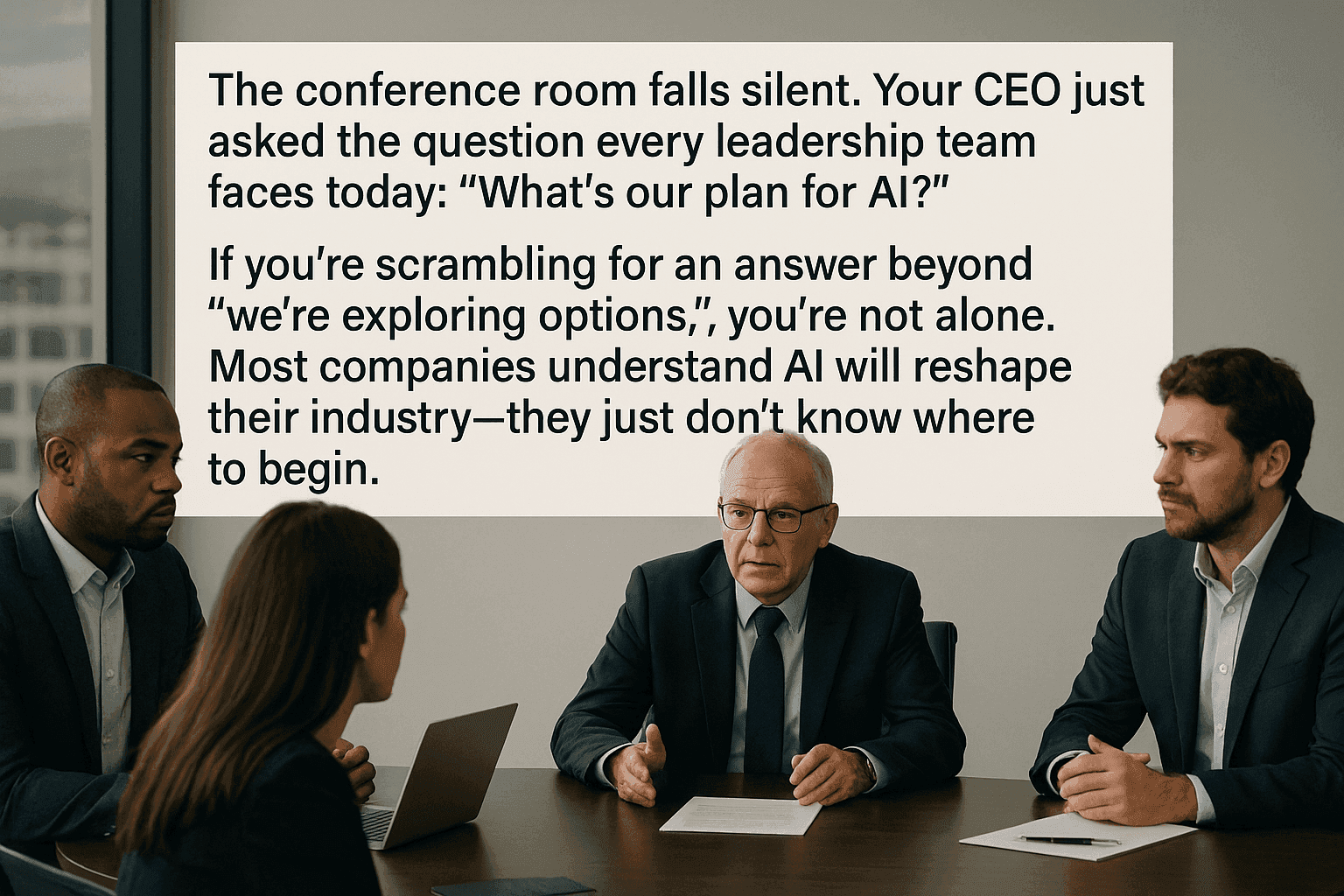
The conference room falls silent. Your CEO just asked the question every leadership team faces today: "What's our plan for AI?" If you're scrambling for an answer beyond "we're exploring options," you're not alone. Most companies understand AI will reshape their industry—they just don't know where to begin.
An AI roadmap isn't about jumping on the latest technology bandwagon or replacing your workforce with robots. It's a strategic document that connects artificial intelligence capabilities to real business problems, creating a clear path from experimental pilots to scaled solutions. Think of it as your organization's GPS for navigating the AI landscape—without it, you might move fast, but you'll likely move in circles.
Understanding What an AI Roadmap Actually Does
Before diving into creation mode, let's clarify what separates a genuine AI roadmap from wishful thinking disguised as strategy. An effective roadmap serves three critical functions that most planning documents miss.
First, it translates abstract AI capabilities into concrete business outcomes. Instead of saying "we'll use machine learning," it specifies "we'll reduce customer churn by 15% using predictive analytics on support ticket patterns." This specificity transforms AI from a buzzword into a measurable investment.
Second, it sequences initiatives based on organizational readiness, not technological sophistication. The most advanced AI solution means nothing if your team can't implement it or your infrastructure can't support it. Your roadmap should build capabilities progressively, like learning to walk before attempting gymnastics.
Third, it creates feedback loops between experiments and strategy. Unlike traditional IT projects with fixed endpoints, AI initiatives generate insights that should reshape your approach. Your roadmap needs built-in mechanisms for learning and pivoting.
Step 1: Audit Your Starting Position
Every AI journey begins with brutal honesty about where you stand today. This isn't about listing your servers or counting data scientists—it's about understanding your organization's true capacity for change.
Start by mapping your data reality. What information do you actually collect, where does it live, and who can access it? Most companies discover their data exists in silos, with customer information in one system, operational metrics in another, and financial records locked away in a third. Document these gaps without judgment—you're creating a baseline, not a report card.
Next, assess your team's AI literacy across all levels. Can your executives articulate how AI differs from traditional software? Do your managers understand enough to spot opportunities in their departments? Are your front-line employees prepared for AI-augmented workflows? The answers reveal where education must precede implementation.
Evaluate your technical infrastructure through the lens of AI requirements. Machine learning models need computational power, data pipelines require robust integration, and real-time AI demands low-latency systems. But don't assume you need everything immediately—your roadmap should align infrastructure investments with actual use cases.
Finally, examine your organizational culture's appetite for experimentation. AI projects often fail initially, require iteration, and challenge existing processes. Companies that punish failure or resist change will struggle regardless of their technical capabilities. If your culture needs adjustment, that work begins before any algorithm runs.
Step 2: Define Success in Business Terms
The biggest mistake in AI planning is starting with technology rather than outcomes. Your roadmap should begin with clear business objectives that AI can meaningfully impact.
Frame these objectives as problem statements, not solution prescriptions. Instead of "implement computer vision," articulate "reduce quality inspection time by 50% while maintaining 99.9% defect detection." This framing keeps focus on value creation rather than technology deployment.
Prioritize problems where AI offers unique advantages over traditional approaches. Look for scenarios involving pattern recognition in massive datasets, prediction based on complex variables, or optimization across multiple constraints. These represent AI's sweet spots where return on investment becomes compelling.
Establish measurable success criteria for each objective. Beyond obvious metrics like cost reduction or revenue increase, consider second-order effects: employee satisfaction from eliminating mundane tasks, customer trust from improved personalization, or competitive advantage from faster decision-making. These broader impacts often justify AI investments when direct ROI seems marginal.
Create a portfolio approach to risk and reward. Your roadmap should balance quick wins that build momentum, strategic bets that could transform your business, and defensive moves that prevent disruption. This diversity ensures your AI strategy survives both early setbacks and changing market conditions.
Step 3: Build Your AI Implementation Plan in Phases
With objectives defined, structure your roadmap as a series of phases that build upon each other. This phased approach manages risk while creating compound learning effects.
Phase 1 should focus on foundational elements and proof of concept. Select one or two well-defined problems where data exists, success metrics are clear, and failure won't cripple operations. These pilots serve as learning laboratories where your team develops AI muscles in a controlled environment. Run these experiments in parallel with data infrastructure improvements and team education initiatives.
Phase 2 expands successful pilots while introducing new use cases. Here, you're not just scaling what worked—you're applying lessons learned to adjacent problems. If your customer service chatbot succeeded, consider expanding AI to sales qualification or technical support. This phase also introduces more sophisticated AI techniques as your team's expertise grows.
Phase 3 integrates AI capabilities across business functions. Instead of isolated AI projects, you're now building interconnected systems where insights from one area inform decisions in another. Your supply chain AI talks to your demand forecasting model, which influences your dynamic pricing algorithm. This integration multiplies AI's impact beyond individual use cases.
Phase 4 represents transformation, where AI becomes embedded in your company's DNA. New products incorporate AI from conception, employees instinctively identify AI opportunities, and your competitive advantage stems from proprietary AI capabilities. Few companies reach this phase quickly, but having it in your roadmap provides directional clarity.
Step 4: Develop Your AI Strategy Framework
Beyond project sequencing, your roadmap needs a strategic framework addressing how AI initiatives connect, compete for resources, and create cumulative advantage.
Establish governance structures that balance innovation with control. Create an AI center of excellence that provides expertise and standards without becoming a bottleneck. Define clear ownership between business units that understand problems and technical teams that understand solutions. This structure prevents both shadow AI projects and ivory tower solutions.
Design your data strategy as the foundation for all AI efforts. Determine what data you'll collect, how you'll ensure quality, where you'll store it, and who can access it. Address privacy and security from the start—retroactively fixing these issues costs exponentially more than building them in initially.
Plan your talent strategy beyond just hiring data scientists. Identify which capabilities you'll build internally versus access through partners. Create career paths that retain AI talent once you've developed it. Design training programs that upskill existing employees rather than replacing them. Remember that domain expertise plus basic AI knowledge often trumps pure technical brilliance.
Develop partnerships strategically rather than opportunistically. Decide where you'll use off-the-shelf solutions, where you'll customize vendor platforms, and where you'll build proprietary systems. These decisions should reflect your competitive strategy—don't outsource capabilities that could become differentiators.
Step 5: Address the Human Side of AI Transformation
Technology roadmaps often fail because they underestimate human factors. Your AI roadmap must acknowledge and address the organizational changes required for success.
Communication strategy matters more than most teams realize. Employees fear AI will replace them, customers worry about privacy, and investors want immediate returns. Develop clear narratives for each audience that acknowledge concerns while articulating benefits. Transparency about AI's role builds trust faster than vague reassurances.
Design change management into each phase. Before launching an AI initiative, identify whose work will change, what new skills they'll need, and how success will affect their roles. Provide training before it's needed, involve affected teams in design decisions, and celebrate early adopters who embrace new approaches.
Address ethical considerations proactively. Establish principles for AI use that reflect your company's values. Create review processes for AI decisions that impact customers or employees. Build explainability into systems where transparency matters. These ethical frameworks prevent future crises while building stakeholder confidence.
Plan for resistance and setbacks. Some employees will sabotage AI initiatives they perceive as threats. Some projects will fail despite careful planning. Some customers will reject AI-powered interactions. Your roadmap should anticipate these challenges with contingency plans rather than assuming smooth adoption.
Step 6: Create Feedback Mechanisms and Evolution Points
Static roadmaps become obsolete before implementation completes. Build adaptation mechanisms that keep your AI strategy relevant as conditions change.
Establish regular review cycles that examine both progress and premises. Every quarter, assess whether your original objectives remain valid, whether new opportunities have emerged, and whether your approach needs adjustment. These reviews should involve diverse perspectives—technical teams might miss business implications while executives might not grasp technical constraints.
Create learning capture processes that transform individual project insights into organizational knowledge. When an AI pilot fails, document why. When integration proves harder than expected, understand root causes. When benefits exceed projections, identify amplifying factors. This knowledge accumulation accelerates future efforts.
Monitor external developments that could reshape your roadmap. New AI breakthroughs might enable previously impossible use cases. Regulatory changes might constrain certain applications. Competitor moves might accelerate your timeline. Your roadmap should specify triggers that prompt strategic reassessment.
Design exit ramps for initiatives that aren't working. The sunk cost fallacy runs rampant in AI projects where teams keep tweaking models hoping for breakthrough performance. Define clear criteria for killing projects, and make these decisions quickly to reallocate resources to more promising opportunities.
Step 7: Budget for Reality, Not Optimism
Financial planning for AI initiatives requires different thinking than traditional IT projects. Costs are less predictable, benefits take longer to materialize, and resource needs evolve as understanding improves.
Front-load investments in foundation over features. Data infrastructure, team training, and governance frameworks consume budgets without delivering visible results. However, skimping on these elements guarantees future initiatives will cost more and deliver less. Your roadmap should explicitly sequence these foundational investments.
Plan for iteration costs that most budgets ignore. AI projects rarely work perfectly initially—models need retraining, interfaces need refinement, and integrations need adjustment. Budget 30-50% above initial estimates for this iteration phase, which often determines whether pilots become products.
Account for hidden costs beyond technology. Legal reviews of AI decisions, compliance with emerging regulations, and insurance for AI-related risks add expenses traditional projects avoid. Change management, extensive training, and productivity dips during transition also impact total cost of ownership.
Model benefits conservatively with staged realization. AI rarely delivers immediate, dramatic improvements. Benefits typically emerge gradually as models improve, adoption increases, and processes adjust. Your financial projections should reflect this reality rather than hockey-stick growth curves that never materialize.
Moving from Roadmap to Reality
Creating your AI roadmap is just the beginning. The real work lies in execution, which requires sustained commitment beyond initial enthusiasm.
Start implementation immediately with small steps. While perfecting your roadmap, begin pilot projects that generate learning. These early experiments inform roadmap refinement while building organizational momentum. Analysis paralysis kills more AI initiatives than technical failures.
Communicate progress relentlessly. Share pilot results, celebrate small wins, and be transparent about challenges. Regular updates maintain stakeholder engagement through the long journey from experimentation to transformation. Silence breeds skepticism that undermines support when you need it most.
Measure everything, but don't let metrics become masters. Track technical performance, business impact, and organizational adoption. But remember that some of AI's greatest benefits—improved decision-making, enhanced creativity, or increased agility—resist easy quantification. Your roadmap succeeds when AI becomes invisible infrastructure enabling better outcomes.
Accept that your first roadmap won't be your last. AI capabilities evolve rapidly, your organization's needs shift, and early experiences reshape understanding. Treat roadmap creation as an ongoing process rather than a one-time exercise. The companies that win with AI aren't those with perfect plans—they're those that learn and adapt fastest.
The Path Forward
Your AI roadmap shouldn't read like science fiction or a vendor's product catalog. It should tell a clear story of how your organization will thoughtfully adopt AI to solve real problems, create new opportunities, and build lasting advantage.
The best roadmaps acknowledge that AI transformation is as much about people as technology. They balance ambition with pragmatism, innovation with risk management, and speed with sustainability. Most importantly, they provide enough structure to coordinate efforts while maintaining flexibility to capitalize on discoveries along the way.
Creating this roadmap requires honest assessment, careful planning, and sustained commitment. But the alternative—reactive, fragmented AI experiments—wastes resources while competitors build systematic advantages. The question isn't whether you need an AI roadmap, but whether you'll create one that actually guides your journey versus decorates your PowerPoint.
Start building your roadmap today, but start small. Pick one business problem, assemble a cross-functional team, and begin mapping the path from current state to AI-enabled future. Each step teaches lessons that improve the next phase. Before long, you'll have transformed from an organization talking about AI to one systematically building competitive advantage through artificial intelligence.
The journey from AI curious to AI capable doesn't happen overnight. But with a thoughtful roadmap guiding your way, each step moves you closer to a future where artificial intelligence amplifies human potential throughout your organization. The only real failure is never beginning the journey at all.