
I was in a meeting last month where someone proudly announced their company was "using AI" to send automated email responses. Spoiler alert: they weren't. They were using a basic if-then rule that's been around since the 1990s. But everything's AI now, right?
Here's the problem: we've turned AI into a catch-all term for anything that seems remotely smart or automated. Your email filter? AI. Your thermostat? AI. That Excel macro? Believe it or not, also AI according to some marketing departments.
This confusion isn't just annoying—it's expensive. Companies are making bad decisions because they don't understand what they're actually buying or building. They're paying AI prices for automation solutions. They're expecting machine learning results from rule-based systems. And then wondering why things don't work out.
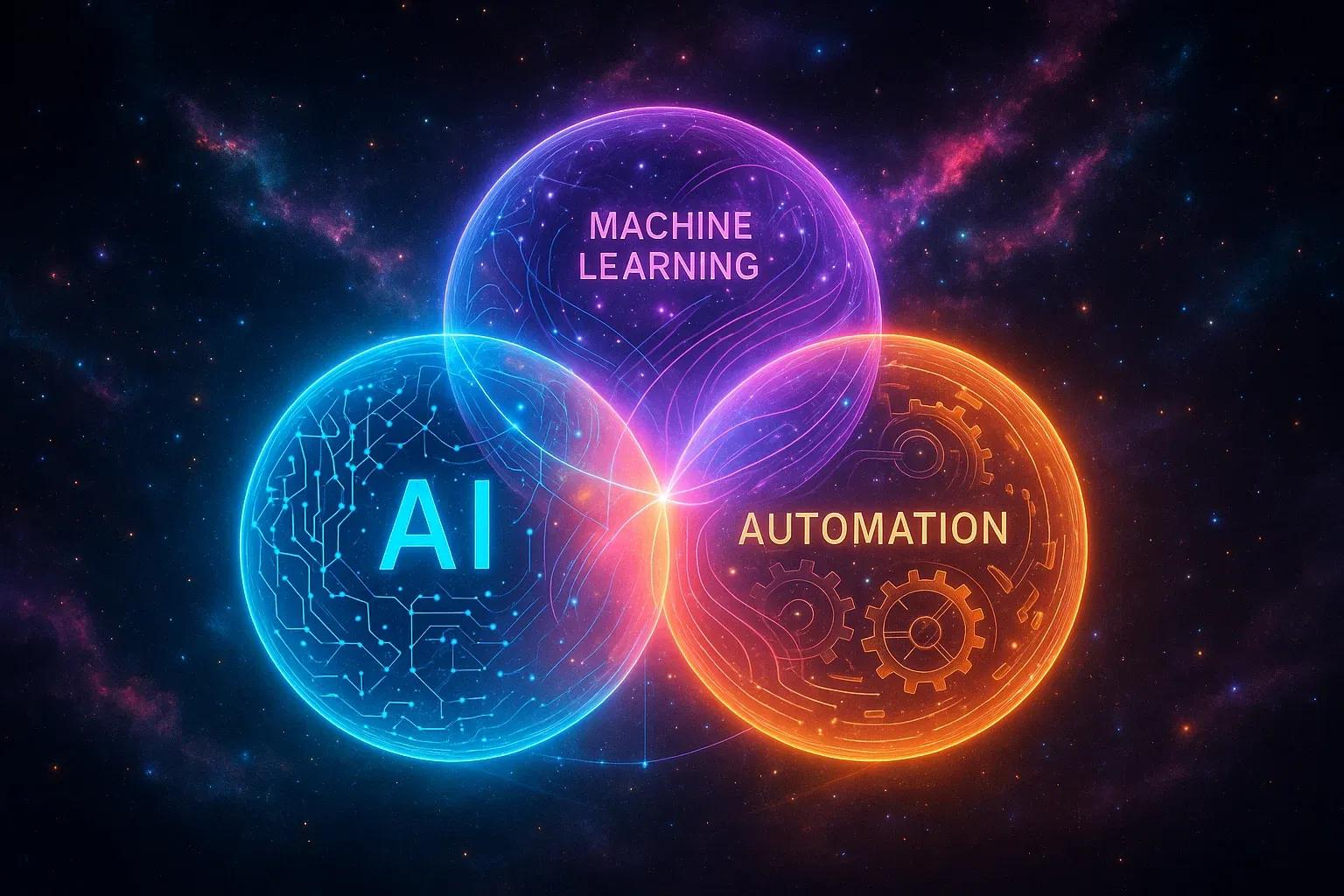
Let's clear this up once and for all. AI, machine learning, and automation are related concepts, but they're not the same thing. Understanding the differences will save you from costly mistakes and help you actually use the right tool for the right job.
Automation: Following the Recipe
Start with automation because it's the simplest and oldest of these concepts. Automation is basically having a system follow a predetermined set of instructions without human intervention.
Think of automation like a recipe. You write down the exact steps, and the system follows them precisely, every single time. If this happens, do that. When you see X, perform Y. It's deterministic—given the same inputs, you always get the same outputs.
Business process automation is everywhere, even if you don't call it that. When you set up an email rule to automatically file messages from your boss into a specific folder, that's automation. When your accounting software generates invoices on the first of every month, that's automation. When your website sends a password reset email after someone clicks "forgot password," you're looking at automation.
The key characteristic? You're telling the system exactly what to do in every situation you've anticipated. There's no learning, no adapting, no figuring things out. Just: "When condition A occurs, execute action B."
This sounds limiting, but automation is incredibly powerful for the right use cases. It's reliable, predictable, and doesn't require huge computational resources. If you can map out all the rules clearly, automation works beautifully.
The problems start when situations arise that you didn't explicitly program for. Traditional automation can't handle ambiguity or make judgment calls. It can't adapt to new patterns or learn from experience. It just follows its instructions, for better or worse.
Machine Learning: Finding Patterns You Didn't Know Existed
Now let's talk about machine learning, which is where things get more interesting and significantly more complex.
Machine learning doesn't follow explicit instructions. Instead, you feed it examples, and it figures out patterns on its own. You're not telling it the rules—you're letting it discover the rules by looking at data.
Here's a practical example: Imagine you want to predict which customers are likely to cancel their subscriptions. With automation, you'd need to manually identify all the warning signs—hasn't logged in for 30 days, reduced usage by 50%, submitted two support tickets, whatever—and program rules based on those factors.
With machine learning, you'd feed the system data about thousands of past customers, including who canceled and who didn't. The algorithm would analyze that data and identify patterns you might never have noticed. Maybe customers who access the platform on Tuesdays but not Wednesdays are more likely to churn. Maybe there's a complex interaction between usage frequency, feature adoption, and billing cycle timing that predicts cancellation.
The machine learning system isn't following your rules—it's creating its own model based on what it learned from the data.
This is powerful, but it comes with trade-offs. Machine learning systems need lots of data to learn from. They require more computational power. And here's the kicker: they're probabilistic rather than deterministic. They make predictions with varying degrees of confidence, not absolute certainties.
You also can't always understand exactly why a machine learning system made a particular decision. It's discovered patterns in multi-dimensional space that humans can't easily visualize or articulate. This "black box" nature makes some people uncomfortable, especially in regulated industries.
Machine learning shines when you have complex patterns, lots of data, and situations where the rules aren't obvious or change over time. It struggles when you have limited data, need complete transparency, or require 100% reliability in every single case.
AI: The Umbrella That Covers It All
Here's where it gets tricky. Artificial intelligence is a broad term that technically includes machine learning but also encompasses a lot more.
AI, in the academic sense, is about creating systems that can perform tasks that typically require human intelligence. That includes things like understanding language, recognizing images, making decisions, solving problems, and planning.
Machine learning is one approach to creating AI, but it's not the only one. You can build AI systems using other methods—rule-based expert systems, symbolic reasoning, evolutionary algorithms, and various combinations of techniques.
The confusion happens because when most people say "AI" today, they're usually referring specifically to modern machine learning approaches, particularly deep learning with neural networks. That's what powers ChatGPT, image recognition systems, and most of the AI applications getting attention right now.
But technically, that old expert system from the 1980s that helped doctors diagnose diseases using thousands of hand-coded rules? That was also AI. It just wasn't machine learning.
For practical business purposes, when someone talks about implementing AI, you need to ask what they actually mean. Are they talking about:
• Basic automation with some smart-sounding features?
• Traditional machine learning that finds patterns in your data?
• Advanced deep learning that can handle complex tasks like understanding natural language?
• Some combination of all these things?
The answer matters because the requirements, costs, and capabilities are completely different.
Intelligent Automation: Where Everything Comes Together
Now we get to intelligent automation, which is basically what happens when you combine traditional automation with AI capabilities.
Think of intelligent automation as automation that can handle exceptions and variations it wasn't explicitly programmed for. It follows rules when appropriate but can make intelligent decisions when it encounters new situations.
A simple example: Traditional automation might file incoming emails based on explicit rules you've defined—sender address, specific keywords in the subject line, that sort of thing. Intelligent automation could understand the actual content and intent of emails, even if they're worded in ways you never anticipated, and route them appropriately.
This is where a lot of practical business value lives. You get the reliability and predictability of automation for standard situations, but with AI handling the edge cases and complexity.
Intelligent automation might use machine learning to improve over time, learning from corrections and new examples. It might use natural language processing to understand text. It might use computer vision to process documents. But it's all in service of automating processes more effectively than pure rule-based systems could.
When to Use What
So how do you know which approach makes sense for your situation? Let's get practical.
Use traditional automation when:
• You can clearly define all the rules and steps
• The process doesn't vary much
• You need complete reliability and predictability
• You want something simple to implement and maintain
• The cost of errors is high and you need complete control
Things like scheduling reports, backing up data, routing standard requests, processing routine transactions—these are perfect for traditional automation.
Use machine learning when:
• Patterns exist but you can't easily articulate all the rules
• You have plenty of relevant data to learn from
• The situation changes over time and the system needs to adapt
• You're okay with probabilistic results rather than certainty
• Human-level judgment would improve the outcome
Fraud detection, personalized recommendations, demand forecasting, image recognition—these benefit from machine learning's ability to find complex patterns.
Use broader AI approaches when:
• You need to handle natural language understanding
• The task requires reasoning or planning
• You want systems that can handle genuinely novel situations
• You need something approaching human-level understanding in specific domains
Think customer service chatbots, content generation, complex decision support systems.
Use intelligent automation when:
• You're automating processes that have both routine and exceptional cases
• You want the efficiency of automation with the flexibility of AI
• You need systems that can improve over time
• You're dealing with unstructured data like documents, emails, or images
Invoice processing, customer onboarding, data entry from varied sources—these benefit from combining automation's efficiency with AI's adaptability.
The Cost and Complexity Factor
Here's something nobody likes to talk about: AI and machine learning are expensive and complicated. Not just the technology itself, but the data infrastructure, the expertise, the ongoing maintenance.
Traditional automation is comparatively cheap and straightforward. If it solves your problem, use it. Don't overcomplicate things just because AI sounds cooler.
I've seen companies spend six months implementing a machine learning solution for a problem that could have been solved with three days of automation work. They did it because "AI" looked better in the board presentation. That's not strategy—that's expensive theater.
On the flip side, trying to solve genuinely complex problems with basic automation leads to unmaintainable messes. Rules stacked on rules stacked on exceptions to rules until nobody understands how anything works and the whole thing breaks constantly.
Match the solution to the problem. Boring automation that works beats cutting-edge AI that doesn't.
Looking at Real Scenarios
Let's walk through some examples to make this concrete.
Customer service routing: Traditional automation might route tickets based on keywords. Machine learning could understand the actual issue being described and route accordingly. Full AI might engage with the customer, ask clarifying questions, and either solve the problem or route to the perfect specialist.
Expense report processing: Automation handles reports that follow standard formats perfectly. Intelligent automation can read receipts in various formats, extract the relevant information, flag anomalies, and route exceptions to humans.
Marketing emails: Automation sends the same email to everyone on a schedule. Machine learning personalizes which email version each person receives based on their past behavior. AI might generate customized content for each recipient based on their specific interests and interaction history.
See the pattern? It's not about one being better than the others. It's about matching capability to need.
The Bottom Line
The difference between AI vs machine learning vs automation isn't just semantic—it's practical. These are different tools with different capabilities, costs, and appropriate use cases.
Automation follows your rules. Machine learning discovers patterns in data. AI encompasses various approaches to mimicking human intelligence. Intelligent automation combines these elements to handle real-world complexity.
Stop calling everything AI. Start asking what you actually need. Most business problems can be solved with smart automation. Some genuinely benefit from machine learning. A few require more advanced AI approaches. Many benefit from thoughtful combinations of all three.
The companies succeeding with these technologies aren't the ones using the buzziest terms. They're the ones honestly assessing their problems and matching them with appropriate solutions. Be one of those companies.