
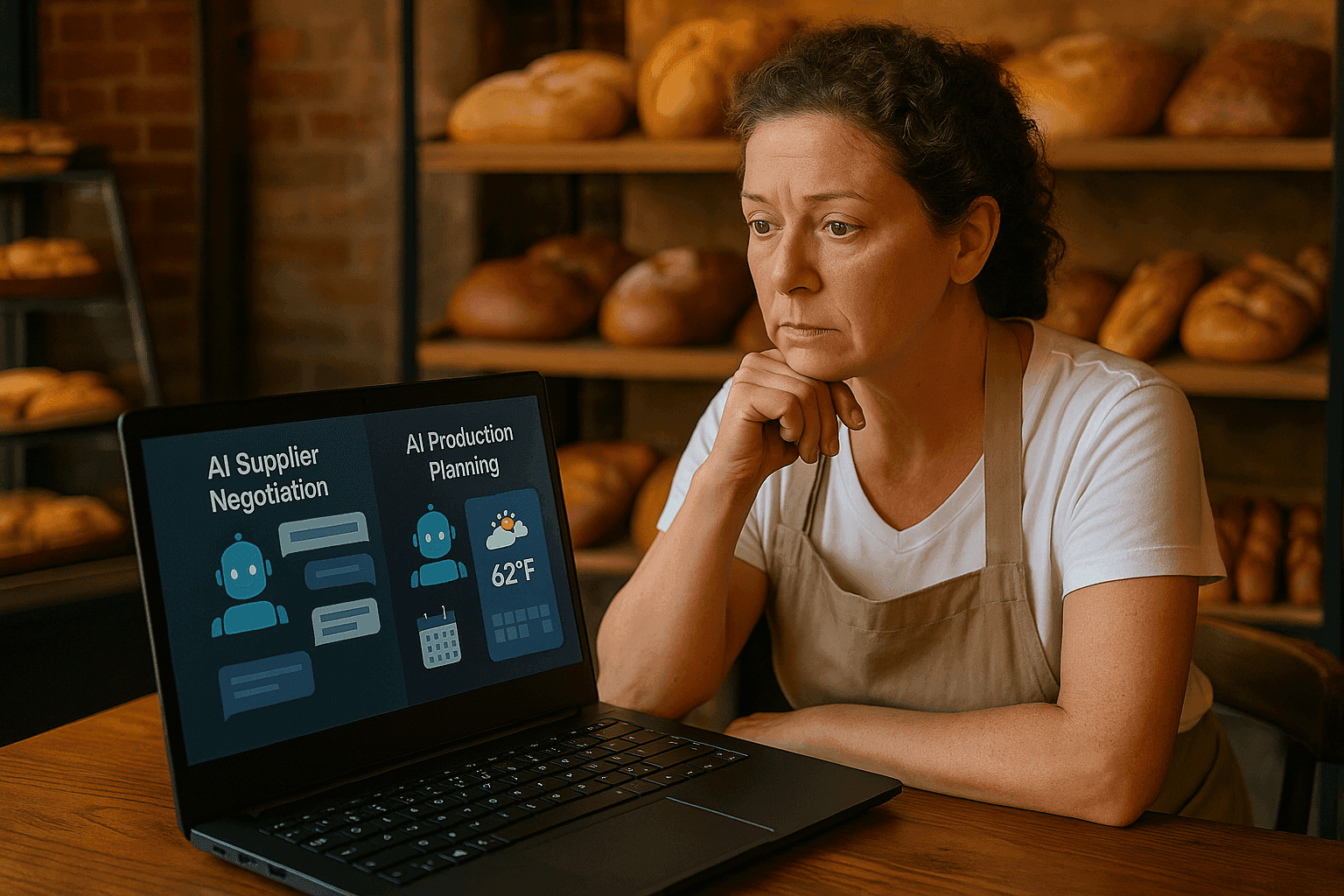
The local bakery owner stares at her laptop screen, watching an AI assistant negotiate with suppliers while another system adjusts tomorrow's production based on weather forecasts and local event schedules. Two years ago, she was skeptical about even using digital payment systems. Today, artificial intelligence handles tasks she didn't know could be automated, freeing her to perfect new recipes and connect with customers.
This scene isn't from some distant future—it's happening right now in small businesses across every industry. The AI trends small business owners are experiencing in 2025 have little to do with the hysteria of robots taking over. Instead, they represent practical tools becoming accessible to companies that measure employees in dozens, not thousands, and budgets in thousands, not millions.
The democratization of AI has reached an inflection point where sophisticated capabilities no longer require sophisticated resources. What Fortune 500 companies spent millions developing three years ago, small businesses now access for the price of a monthly software subscription. This shift fundamentally alters how smaller enterprises compete, operate, and grow.
1. Micro-AI: Specialized Intelligence for Specific Problems
Forget the pursuit of all-knowing artificial general intelligence. The most significant AI trend impacting small businesses involves narrow, focused systems that excel at single tasks. These "Micro-AI" solutions don't try to replicate human thinking—they simply solve specific problems better than any human could.
Consider the neighborhood accountant using AI that only does one thing: categorize expenses from bank statements. It doesn't prepare tax returns, generate financial advice, or predict market trends. It just categorizes expenses with 99.8% accuracy in seconds rather than hours. This focused functionality costs $30 monthly instead of $3,000 for comprehensive accounting software most features of which go unused.
Small businesses are building competitive advantages by stacking these micro-solutions. A local restaurant might use one AI for inventory prediction, another for scheduling staff, and a third for responding to reviews. Each tool operates independently, requiring no integration or technical expertise. The restaurant owner doesn't need to understand machine learning any more than they need to understand internal combustion to drive a car.
The beauty of Micro-AI lies in its approachability. Training happens through normal use—the system learns from corrections and patterns without formal programming. A boutique owner doesn't upload datasets or configure neural networks; they simply approve or correct the AI's suggestions about which products to reorder, and the system gradually improves its predictions.
This trend particularly benefits businesses with unique niche requirements that enterprise software ignores. A specialty craft store can find AI that understands seasonal quilting fabric demand patterns. A food truck can deploy AI that predicts optimal locations based on weather, events, and historical sales. These ultra-specific solutions would never justify development costs for large software companies but become viable when AI can be trained rather than programmed.
The financial model has also shifted to match small business realities. Instead of large upfront investments, these tools operate on usage-based pricing. You pay for what you use, scale up during busy periods, and scale down when things are slow. This flexibility means AI adoption no longer requires betting the business on technology that might not deliver.
Looking ahead through 2025, expect to see thousands of these micro-AI tools emerge, each targeting problems specific to particular industries, regions, or business models. The winning small businesses won't be those using the most AI, but those identifying which specific tasks benefit most from automation and finding the focused tools to address them.
2. Conversational Operations: Running Your Business Through Natural Language
The command line interface disappeared from personal computers decades ago, replaced by clicking and tapping. Now, even those interactions are giving way to something more natural: conversation. Small businesses in 2025 are discovering they can operate sophisticated systems simply by describing what they want in plain language.
A plumbing contractor schedules jobs by telling their phone: "Book Mrs. Johnson for Tuesday afternoon, she's near the Miller job from this morning, and remind me to bring the special wrench for her vintage fixtures." The AI understands the context, optimizes the route, checks inventory, and creates the appropriate reminders. No forms, no dropdown menus, no training required beyond speaking clearly.
This shift extends beyond simple commands to complex business decisions. A boutique owner can ask: "Show me which products have been sitting longest and suggest discount percentages that would move them while maintaining decent margins." The AI doesn't just retrieve data—it understands intent, applies business logic, and presents actionable recommendations in conversational form.
The technology enabling this trend has matured beyond early voice assistants that frustrated more than they helped. Modern conversational AI understands context, remembers previous interactions, and learns individual speaking patterns. It handles accents, industry jargon, and even emotional nuance. When the florist sounds stressed while ordering inventory, the system might suggest: "You seem rushed—should I use last week's standing order as a template?"
Small businesses benefit disproportionately from conversational interfaces because they often lack dedicated IT staff. The owner wearing multiple hats doesn't have time to learn complex software. But they can easily describe what they need while driving between job sites or preparing tomorrow's pastries. The interface adapts to their workflow rather than forcing workflow changes to accommodate technology.
Integration happens through conversation too. Instead of complex API configurations, business owners connect services by granting permission through natural dialogue. "Let the scheduling system talk to my payment processor" becomes the entirety of the integration process. The AI handles the technical details invisibly.
Privacy and security concerns that once limited adoption have been addressed through innovative approaches. Conversational AI now processes sensitive commands locally on devices when possible, sending only necessary information to cloud services. Small businesses can discuss financial details or customer information without fearing eavesdropping or data breaches.
The implications ripple throughout organizations. Employees at every level can access information and execute tasks without technical training. The new cashier can ask the system how to process returns for items bought on sale. The delivery driver can report vehicle maintenance needs through voice notes that automatically convert to work orders.
By late 2025, industry observers predict that 60% of small business software interactions will happen through natural language rather than traditional interfaces. This doesn't mean screens disappear—visual confirmation and complex data still require display. But the primary mode of operation shifts from clicking through menus to simply stating intentions and receiving intelligent responses.
3. Collaborative AI Workforce: Digital Employees That Actually Work
The concept of AI "replacing" workers has evolved into something more nuanced and practical for small businesses: AI team members that collaborate with human employees rather than supplanting them. These digital colleagues handle specific roles with consistency and reliability, freeing human workers for tasks requiring creativity, empathy, and judgment.
A small marketing agency employs an AI team member named "Riley" who handles first-draft copywriting. Riley doesn't replace the creative director; instead, it produces ten headline variations in the time a human might craft one, providing raw material for refinement. The human copywriter spends time perfecting language rather than staring at blank pages, multiplying their effective output.
These AI workforce members come with defined roles, capabilities, and even personalities tailored to business culture. A law firm's AI paralegal maintains formal communication styles and meticulous attention to detail. A surf shop's AI customer service representative embeds casual beach culture into its interactions. This personality alignment helps human employees accept AI colleagues as team members rather than threatening technologies.
The economics make sense for small businesses in ways previous automation didn't. Hiring a full-time social media manager might cost $40,000 annually, beyond many small business budgets. But an AI social media team member costs $200 monthly, handles posting schedules, responds to routine comments, and flags items requiring human attention. The business owner reviews and approves content during coffee breaks rather than spending hours on social platforms.
Training these AI employees happens through demonstration rather than programming. When the AI observes how humans handle specific situations repeatedly, it learns to replicate those approaches. A boutique's AI stylist learns combination preferences by watching which outfits human stylists create. A restaurant's AI host learns greeting styles and table preferences through observation rather than explicit rules.
Small businesses are discovering optimal human-AI team compositions for different functions. Customer service might use AI for initial response and routine queries while humans handle complex problems and upset customers. Sales teams use AI for lead qualification and follow-up while humans conduct actual negotiations. This division plays to each party's strengths while covering weaknesses.
The legal and practical framework for AI workers has clarified significantly. Businesses now understand liability boundaries, when human oversight is required, and how to maintain compliance while using AI team members. Insurance products specifically covering AI-related risks have emerged at small business price points, removing a significant adoption barrier.
Performance management extends to AI team members too. Small businesses track metrics like response time, customer satisfaction, and error rates for their AI employees just as they would human staff. Underperforming AI gets retrained or replaced. High-performing AI might get "promoted" to handle more complex tasks as its capabilities improve.
The psychological shift proves as important as the technological one. Small business owners who once feared AI would destroy jobs now see it as a way to offer better jobs. Instead of hiring someone to spend eight hours daily doing data entry, they hire someone to spend those hours analyzing data insights and developing strategy. Employee satisfaction increases when mundane tasks disappear from job descriptions.
4. Predictive Micro-Logistics: Supply Chain Intelligence for the Small
Large corporations have used AI for supply chain optimization for years, but those solutions assumed global operations and million-dollar budgets. The future of AI for SME AI adoption in 2025 brings predictive logistics capabilities scaled for businesses measuring inventory in hundreds, not millions, of units.
A small hardware store now predicts which specific screws will sell this weekend based on weather forecasts, local construction permits, and even social media chatter about DIY projects. This isn't generic seasonal adjustment—it's hyperlocal prediction that understands this neighborhood's unique patterns. The system knows that rain on Tuesday means increased sales of tarps on Monday and decreased sales of paint until Thursday.
These predictive systems work with imperfect, limited data that characterizes small business operations. Unlike enterprise systems requiring years of historical data in specific formats, small business AI learns from whatever information exists: handwritten inventory logs, basic POS systems, even the owner's mental notes captured in voice memos. The AI fills gaps through inference and external data sources rather than demanding perfect inputs.
The financial impact becomes substantial through accumulated small optimizations. Reducing inventory holding costs by 15% might only save a small retailer $500 monthly, but that's $6,000 annually—enough to hire seasonal help or upgrade equipment. Preventing stockouts on just the top ten products might increase revenue by 8%. These improvements that seem marginal to large corporations transform small business economics.
Integration with suppliers has become seamless through standardized AI interfaces. A restaurant's AI system can automatically negotiate with multiple suppliers' AI systems, comparing prices, availability, and delivery schedules to optimize orders. This happens without the owner spending hours on phone calls or managing complex vendor relationships. The local buying power aggregates as multiple small businesses' AI systems coordinate joint purchases for better pricing.
Real-time adaptation distinguishes modern micro-logistics from traditional inventory management. When a local festival gets announced, the AI immediately adjusts projections and suggests orders. If a competitor closes unexpectedly, the system recognizes the opportunity and recommends inventory expansion in specific categories. This responsiveness previously required either lucky guessing or lost opportunities.
Transportation optimization now includes last-mile delivery for small businesses. AI coordinates delivery routes across multiple small retailers, sharing costs while improving service. The bakery, florist, and gift shop on the same block might share morning delivery runs, with AI determining optimal routing and cost allocation. This collaboration, impossible to coordinate manually, happens automatically through AI negotiation.
Risk management becomes proactive rather than reactive. The AI monitors supplier financial health, weather patterns affecting transportation, and geopolitical events impacting specific products. A small electronics retailer gets warned about potential chip shortages weeks before they impact availability, allowing time to stock up or find alternatives. This foresight, previously available only to large corporations with dedicated analysts, now comes standard in small business logistics platforms.
5. Emotional Intelligence as a Service: AI That Reads the Room
Perhaps the most unexpected AI trend impacting small businesses involves systems that understand and respond to human emotions. This isn't about robots pretending to have feelings—it's about AI recognizing emotional states and adapting interactions accordingly, helping small businesses deliver personalized service that previously required years of human experience.
A dental office's scheduling AI detects anxiety in a patient's voice when booking a appointment and automatically schedules extra time, sends calming preparation materials, and notes the emotional state for staff awareness. The dentist arrives prepared for a nervous patient without awkward questioning or assumptions. This emotional awareness transforms routine interactions into trust-building moments.
Small retail businesses use emotional AI to recognize customer mood through facial expressions and body language, alerting staff when someone seems frustrated or confused. The technology doesn't make decisions—it empowers human employees with information they might miss while multitasking. A customer silently struggling to find something gets approached proactively, turning potential abandonment into successful sales.
The application extends to employee management, where AI helps small business owners navigate complex interpersonal dynamics. The system might notice that team meetings consistently become tense when certain topics arise or that productivity drops when specific employees work together. These insights, presented privately to management, help address problems before they escalate into conflicts or resignations.
Customer service interactions benefit enormously from emotional awareness. An AI chat system recognizes escalating frustration and immediately offers human assistance rather than continuing automated responses. It distinguishes between customers who want quick, efficient service and those who need detailed explanations. This adaptation happens invisibly, with customers simply experiencing mysteriously good service.
Training and development incorporate emotional intelligence too. Small businesses use AI coaching systems that adapt teaching styles based on emotional responses. If an employee seems overwhelmed learning new software, the AI slows down and offers encouragement. If they appear bored, it accelerates and introduces challenges. This personalized training proves especially valuable for small businesses that can't afford dedicated trainers.
Marketing messages adjust based on collective emotional trends. A coffee shop's AI might notice that Monday morning customers respond better to energetic, motivational messaging while Friday afternoon crowds prefer relaxed, celebratory tones. Email campaigns automatically adjust language and imagery based on recipient emotional profiles built from previous interactions.
The technology handles cultural and generational differences in emotional expression. What signals frustration in one demographic might indicate engagement in another. The AI learns these nuances through observation, helping small businesses serve diverse communities without making cultural assumptions or mistakes.
Privacy safeguards have evolved to address obvious concerns about emotional surveillance. Modern systems process emotional indicators locally when possible, store only aggregated patterns rather than individual emotional profiles, and provide clear opt-out mechanisms. Small businesses can offer emotionally intelligent service while respecting customer boundaries and maintaining trust.
The Compound Effect: When Trends Converge
These five trends gain power through combination. A small business might use conversational AI to communicate with their AI team member, who uses emotional intelligence to handle customer interactions while predictive logistics ensures products are available, all powered by specialized micro-AI tools. The sum exceeds the parts, creating operational capabilities that seemed impossible for small businesses just years ago.
The competitive landscape shifts as these technologies become standard rather than exceptional. Small businesses that resist AI adoption risk falling behind not just large corporations but other small businesses that embrace these tools. The local coffee shop using AI to perfect inventory, staffing, and customer service will outperform the one relying solely on intuition and spreadsheets.
Yet success doesn't require adopting every AI trend simultaneously. The most successful small businesses in 2025 are those that thoughtfully select AI tools matching their specific challenges and capabilities. A family restaurant might start with predictive inventory, while a consulting firm begins with AI team members for research. The key lies in starting somewhere rather than waiting for perfect solutions.
The financial barriers continue falling as competition among AI providers intensifies. What cost thousands monthly in 2023 costs hundreds in 2025, and prices continue dropping while capabilities increase. Many AI tools now offer free tiers sufficient for very small businesses, with scaling prices that grow with business success rather than upfront investments.
Education and support systems have evolved to help small businesses navigate AI adoption. Industry associations offer AI readiness assessments, government programs provide implementation grants, and peer networks share practical experiences. The journey from AI-curious to AI-capable no longer requires solo navigation through complex technical terrain.
Preparing for Tomorrow's AI Landscape
As 2025 progresses, these trends will deepen rather than disappear. Micro-AI tools will become even more specialized and accessible. Conversational interfaces will handle increasingly complex operations. AI team members will take on more sophisticated roles. Predictive logistics will anticipate needs before they're recognized. Emotional intelligence will enable deeper human connections despite digital mediation.
Small businesses should view AI not as a technical challenge but as a business evolution. The question isn't whether to adopt AI but which problems to address first. Start with pain points that consume disproportionate time or cause regular frustration. Look for AI solutions that integrate easily with existing operations rather than requiring wholesale transformation.
Success metrics should focus on business outcomes rather than technical sophistication. Did customer satisfaction improve? Did employee stress decrease? Did profit margins expand? These practical measures matter more than how advanced your AI systems appear. The neighborhood bakery using simple AI to reduce waste might achieve better returns than the startup using complex AI ineffectively.
The human element remains paramount. AI amplifies human capabilities rather than replacing human judgment. Small businesses that thrive will be those that use AI to become more human—more responsive to customer needs, more supportive of employee development, more connected to community rhythms. The technology serves the mission, not vice versa.
The future of AI for small businesses isn't about competing with technology giants on their terms. It's about using accessible AI tools to deliver superior local service, deeper customer relationships, and more sustainable operations. The business that knows every customer's name and preferences, always has the right products in stock, and operates with remarkable efficiency doesn't need to be Amazon—it just needs to be irreplaceable in its community.
As these AI trends small business owners are experiencing continue evolving, the winners won't be those with the most advanced technology but those who best blend artificial intelligence with human intelligence to create something neither could achieve alone. The local businesses that master this balance will discover that small size becomes an advantage, enabling agility and personalization that larger competitors cannot match despite their resources.
The AI transformation of small business has begun. The only question remaining is which businesses will seize these opportunities to redefine what's possible when human creativity meets artificial intelligence at the scale where most of the world's business actually happens—on Main Street, not Wall Street.