
You've seen the pitch. "Deploy one AI. Automate your entire business. Watch the revenue flow."
It sounds incredible. It also makes about as much sense as hiring a single person, handing them the titles of CEO, CFO, Head of Sales, Lead Developer, and Customer Support Rep — and expecting them to perform flawlessly at all of them simultaneously.
That person would burn out in a week. Your AI agent? It just silently hallucinates, skips steps, and returns confident-sounding nonsense while you wonder why nothing is actually getting done.
Here's the uncomfortable truth most AI vendors won't tell you: a single LLM prompt is not a workflow. It's a party trick.
The Illusion of the "Do Everything" Agent
When most companies first experiment with AI automation, they build something like this: one prompt, one model, one massive instruction set. "Read the email. Check inventory. Calculate pricing. Draft the quote. Send it."
And sometimes — maybe even often — it kind of works. The demo looks clean. Leadership gets excited.
Then reality hits. The model tries to hold too much context at once. It misreads the email because it was also simultaneously trying to think about pricing logic. It "invents" an inventory figure because it got confused mid-task. It formats the quote incorrectly because by the time it got there, it had already lost track of the original customer request.
This isn't a flaw in the model. It's a flaw in the architecture. You built a one-person operation and then acted surprised when it couldn't scale.
The smartest companies don't ask one AI to do everything. They build a team.
What a Multi-Agent Framework Actually Is
A Multi-Agent framework — think tools like CrewAI, AutoGen, or LangGraph — is an orchestration layer that allows you to deploy multiple specialized AI agents, each with a focused role, passing tasks between them in a structured sequence.
Think of it like a real business unit.
Instead of one overwhelmed generalist, you have:
A Researcher Agent that reads inputs, gathers context, and summarizes what it finds.
A Decision Agent that takes that structured summary and applies business logic or rules.
An Execution Agent that takes a clear decision and converts it into a concrete output — a drafted email, a filled form, an API call.
A Review Agent (optional but powerful) that checks the output before it leaves the system.
Each agent operates with a narrow, clear mandate. It doesn't need to know everything — it just needs to do its part well and hand off cleanly to the next agent in the chain.
The difference in output quality is not incremental. It's categorical.
When you stop asking one model to context-switch constantly, errors don't just reduce — they approach near zero on well-scoped tasks. Each agent's smaller context window is a feature, not a limitation. Focus produces precision.
A Real-World Example: The Quote That Sends Itself
Let's make this concrete. Imagine your sales team receives 40–60 inbound quote requests per day. Right now, someone manually reads each email, checks the CRM, pulls inventory data, does pricing math, drafts the quote, and sends it for manager approval. That process takes 15–25 minutes per request and is riddled with inconsistency.
Here's how a multi-agent workflow handles the same task autonomously:
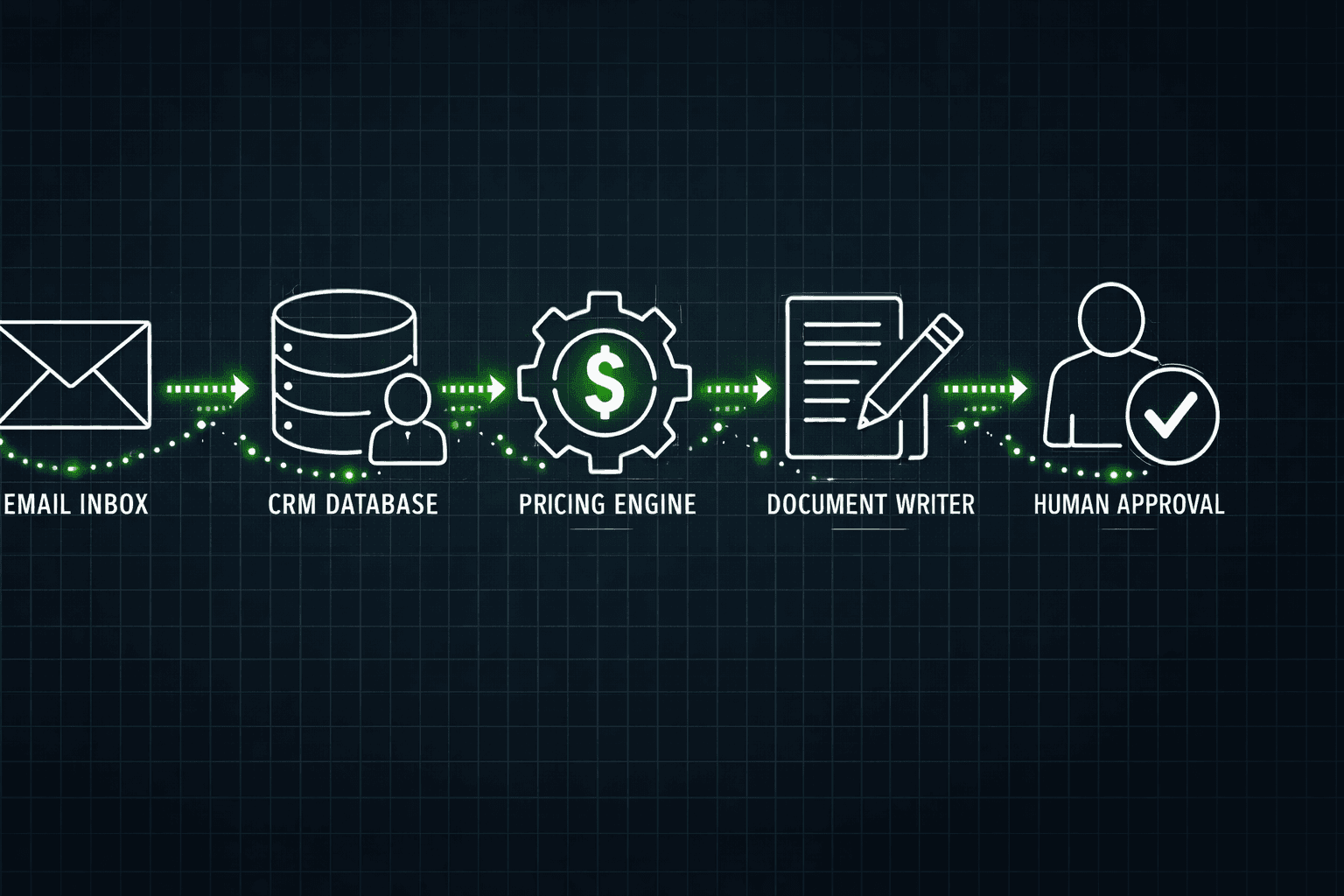
Step 1 — The Intake Agent monitors the shared sales inbox. When a new quote request arrives, it extracts the key data: company name, product requested, volume, delivery timeline, any special terms mentioned. It structures this into a clean summary object and passes it forward.
Step 2 — The CRM & Inventory Agent takes that structured summary and queries your CRM for customer history — are they an existing account? What's their payment record? It simultaneously checks inventory levels and flags any lead time constraints. It produces a fact sheet: what we know about this customer, what we have available, what's relevant.
Step 3 — The Pricing Agent takes the fact sheet and applies your pricing logic. Volume tiers, existing contract terms, margin floors. It calculates the quote figures and generates a formatted draft.
Step 4 — The Drafting Agent takes the numbers and context, and writes the actual quote email — professional, personalized, accurate, in your company's tone and template.
Step 5 — The Approval Router packages everything — the original email, the CRM summary, the draft quote — and fires it to a human approver with a single "Approve / Request Changes" decision to make.
Total elapsed time: under 90 seconds. Human time required: 30 seconds to review and click approve.
What you just built isn't automation in the shallow sense of saving a few keystrokes. You built a system that genuinely thinks in sequence, checks its own work, and only escalates to a human at the moment where human judgment actually adds value.
Why This Matters More Than the Model You're Using
There's a very loud conversation happening right now about which LLM is "the best." GPT-4 vs. Claude vs. Gemini. Benchmarks everywhere.
Mostly, it's the wrong conversation.
A mediocre model inside a well-designed multi-agent architecture will outperform a frontier model running a single chaotic prompt — every single time, on every real-world business task that involves more than two steps.
Architecture is the moat. The agent framework is the strategy. The model is just talent you hire into a well-run organization.
Stop trying to find one AI that does everything. Start building the team.
Where to Start
You don't need to build a 10-agent system on day one. Start with one handoff.
Pick a process in your business with two distinct phases — research and output, or data collection and drafting — and separate them into two agents. Give each one a clear role and a clean data contract between them.
Run it for two weeks. Measure the output quality compared to a single-prompt approach.
The results will tell you everything. And once you see it work, you won't want to go back to hiring a one-person team and calling it an enterprise.
The companies that will dominate AI automation in the next three years aren't the ones who found the smartest single model. They're the ones who figured out how to build teams.