

In today's rapidly evolving digital landscape, businesses across industries are recognizing the transformative power of artificial intelligence (AI). Developing an AI strategy isn't just a trend—it's a necessity for staying competitive. Whether you're a startup or an established enterprise, a well-crafted AI strategy can drive efficiency, innovation, and growth. This how-to guide will walk you through the essential steps to develop AI strategy that aligns with your business goals, incorporating an AI roadmap and AI implementation plan to ensure long-term success.
As we move into 2025 and beyond, AI technologies like generative AI, machine learning, and predictive analytics are reshaping how companies operate. According to recent insights, organizations that prioritize AI are seeing significant returns, with efficiency gains and revenue boosts leading the way. By following this guide, you'll learn how to assess your needs, build a roadmap, and execute an implementation plan that positions your business for AI-driven excellence.
Why Your Business Needs an AI Strategy Now
Before diving into the how-to, it's crucial to understand the "why." AI is no longer a futuristic concept; it's a core driver of business value. In 2025, AI adoption is projected to contribute trillions to the global economy, with sectors like healthcare, finance, and manufacturing leading the charge. Companies without a clear AI strategy risk falling behind competitors who leverage AI for personalized customer experiences, optimized supply chains, and data-driven decision-making.
A winning AI strategy helps you:
Identify Opportunities: Pinpoint areas where AI can solve pain points or create new revenue streams.
Mitigate Risks: Address ethical, regulatory, and security concerns early.
Foster Innovation: Encourage a culture where AI enhances human capabilities rather than replacing them.
Achieve Scalability: Build systems that grow with your business.
Without a strategy, AI initiatives often fail due to misalignment with business objectives or insufficient resources. As one expert notes, the strongest strategies start by aligning AI with clear business goals. In the following sections, we'll outline a step-by-step process to develop AI strategy tailored to your organization.
Step 1: Assess Your Business's AI Readiness
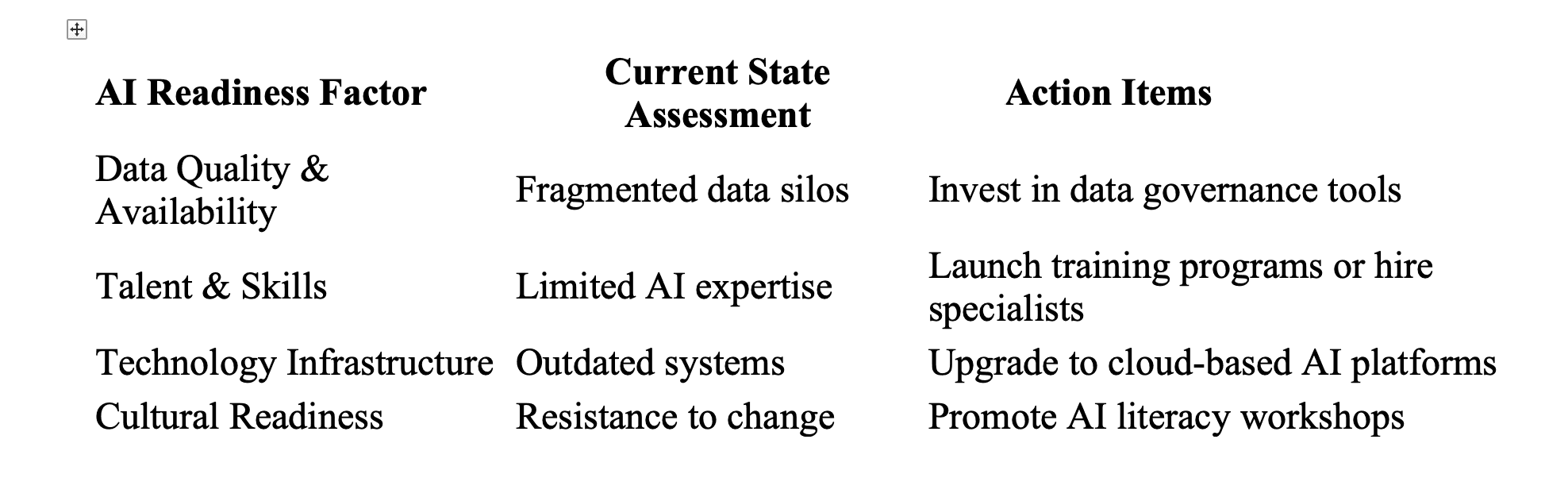
The foundation of any effective AI strategy is a thorough self-assessment. This step involves evaluating your current capabilities, identifying gaps, and understanding your organization's maturity level in AI adoption.
Start by conducting an AI maturity audit. This includes reviewing your data infrastructure, technology stack, and workforce skills. Ask key questions like:
Do we have high-quality, accessible data?
What AI tools or pilots have we already implemented?
Are our employees equipped with the necessary skills?
Tools like maturity models from research firms can help. For instance, assess across pillars such as vision, value realization, risk management, and adoption plans. A simple way to structure this is through a SWOT analysis (Strengths, Weaknesses, Opportunities, Threats) focused on AI.
Step 2: Define Your AI Vision and Objectives
With your readiness assessed, it's time to articulate a compelling AI vision. This vision should align with your overall business strategy, answering: "What does success with AI look like for us?"
Craft a vision statement that's inspiring yet achievable. For example: "Leverage AI to deliver hyper-personalized customer experiences, reducing churn by 20% and boosting revenue by 15% within three years." Make it specific, measurable, and tied to business outcomes.
Next, define objectives using the SMART framework (Specific, Measurable, Achievable, Relevant, Time-bound). Prioritize based on impact:
Short-term: Automate routine tasks to cut costs.
Medium-term: Enhance products with AI features.
Long-term: Transform business models, like shifting to AI-first operations.
Involve leadership to ensure ownership. As strategies evolve, AI itself can aid in strategy development by accelerating analysis and scenario planning. Consider forming an AI steering committee with diverse roles— not just one leader—to drive this forward.
Establish strategic principles, such as ethical AI use or data privacy focus, to guide decisions. This step ensures your AI efforts are purposeful, avoiding the pitfall of technology for technology's sake.
Step 3: Identify High-Impact AI Use Cases
Now, translate your vision into actionable use cases. This is where you brainstorm how AI can address specific business challenges.
Begin with problem identification. Map pain points across departments:
Marketing: Predictive analytics for customer segmentation.
Operations: AI-driven supply chain optimization.
HR: Automated talent acquisition and employee engagement tools.
Use frameworks like value mapping to prioritize use cases based on feasibility, ROI, and strategic alignment. For example, calculate potential value in terms of efficiency gains, revenue uplift, or cost savings.
Explore emerging technologies: Generative AI for content creation, machine learning for fraud detection, or natural language processing for customer service chatbots. In 2025, AI agents are gaining traction for autonomous tasks, starting with clear problem understanding and skill mapping.
Pilot a few use cases to test viability. Gather feedback and iterate. Remember, the best use cases solve real problems and scale across the organization.
Step 4: Build Your AI Roadmap
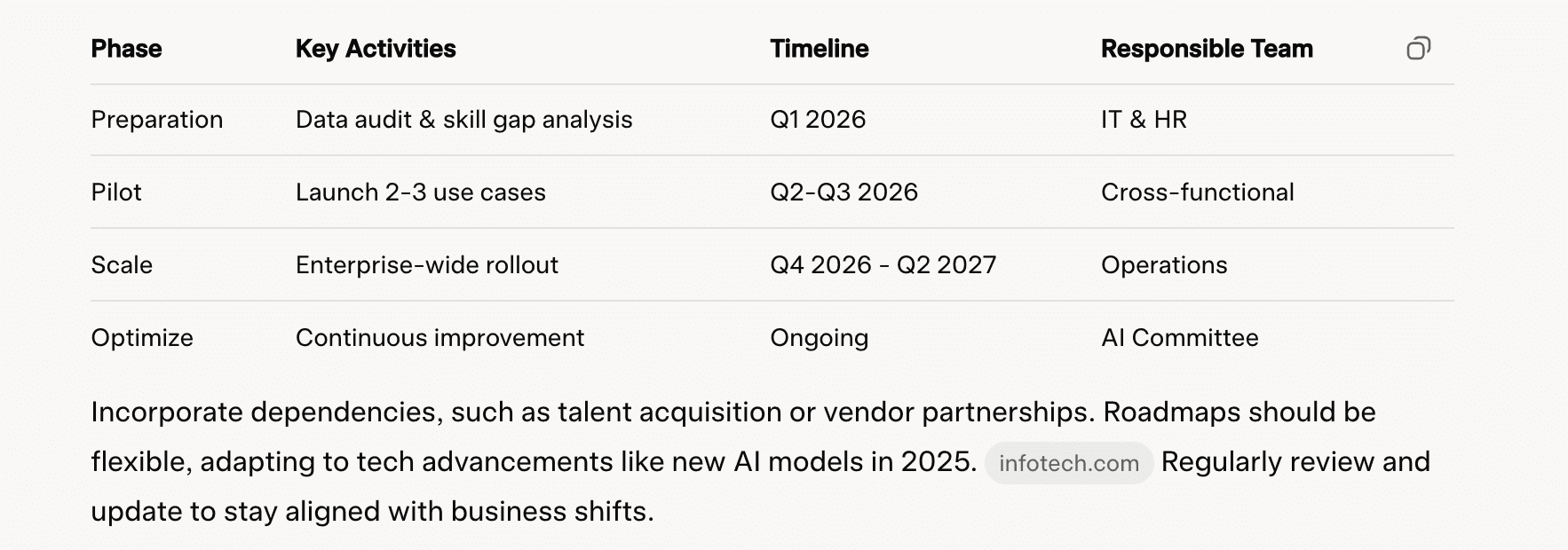
An AI roadmap is your blueprint for progression, outlining milestones from current state to desired future. This secondary keyword—"AI roadmap"—is central here, providing a phased approach.
Structure your roadmap over horizons:
Horizon 1 (1 Year): Foundational builds, like data infrastructure and quick-win pilots.
Horizon 2 (2-3 Years): Scaling use cases and integrating AI into core processes.
Horizon 3 (4-5 Years): Full transformation, such as AI-optimized business models.
Step 5: Create an AI Implementation Plan
The AI implementation plan turns your roadmap into reality. This detailed plan covers resources, timelines, and execution tactics.
Key elements include:
Talent Strategy: Build, buy, or borrow AI expertise. Train existing staff or partner with vendors.
Technology Selection: Choose platforms like cloud AI services. Identify partners for specialized tools.
Data Management: Ensure clean, ethical data pipelines.
Budgeting: Allocate funds for tools, training, and pilots. Expect initial investments to yield ROI within 12-18 months.
Change Management: Prepare employees through training and communication to foster adoption.
Outline a project management approach, using agile methodologies for iterative development. Assign KPIs to each phase, such as adoption rates or cost savings.
For example, in implementation, start by reimagining core processes with AI, then focus on continuous improvement loops. This plan should be documented and shared organization-wide for transparency.
Step 6: Address Risks and Ethical Considerations
No AI strategy is complete without tackling risks. Ethical AI is paramount in 2025, with regulations like GDPR and emerging AI laws demanding compliance.
Common risks:
Bias and Fairness: Audit algorithms regularly.
Security: Protect against data breaches.
Job Displacement: Focus on augmentation, not replacement.
Regulatory Compliance: Stay updated on laws.
Develop a risk management framework, including governance policies and ethical guidelines. Fortify your strategy with robust risk and adoption plans.
Involve legal and ethics experts early. Conduct impact assessments for each use case to ensure responsible AI deployment.
Step 7: Measure Success and Iterate
Success measurement is ongoing. Define metrics tied to objectives, such as ROI, user satisfaction, or process efficiency.
Use dashboards to track progress. Conduct quarterly reviews to adjust your AI roadmap and implementation plan. Feedback loops are essential—gather input from users and stakeholders.
If metrics fall short, pivot quickly. AI strategies thrive on iteration, adapting to new technologies and market changes. Celebrate wins to maintain momentum.
Real-World Case Studies
To illustrate, consider how companies have succeeded:
A retail giant used AI for inventory optimization, reducing waste by 30% through predictive analytics.
A financial firm implemented chatbots, improving customer response times and satisfaction scores.
These examples show the power of a structured approach.
Launch Your AI Journey Today
Developing an AI strategy is a dynamic process that positions your business for future-proof growth. By assessing readiness, defining objectives, building an AI roadmap, and executing a solid AI implementation plan, you'll unlock AI's full potential. Start small, iterate often, and lead with value. In 2025, the businesses that thrive will be those with a winning AI strategy—make yours one of them.